
Sun, spider-fiends and subtler spectres:
a review of A Sunny Place for Shady People – short stories by Mariana Enriquez, translated by Megan McDowell (Granta, 2024)
For Christmas 2025 I was asked for a list of present ideas by my mother-in-law, for whom weird fiction is not familiar ground. Among the books I mentioned were the enticing Mariana Enriquez anthologies published in paperback by Granta. I thought that the somewhat sickening (in the best way) cover illustrations by Pablo Gerardo Camacho might mean that she’d choose a calmer option from the list, but I was delighted to receive both Things We Lost in the Fire (2016) and A Sunny Place for Shady People (2024), mashed-up-face covers and all.
Having now enjoyed the mélange of hauntings, madness and trauma in the twelve stories in the collection, I’ve spun out some thoughts into four sections below – if you prefer to skip to my general review of the book (and the most wobbling tale award), head straight for the third section via the link ☺.
I won’t write a detailed synopsis for each story, but it is possible that reading this post before reading the book may affect your experience if I mention a theme or plot point in the discussion, so with that said, you have been warned…
Cover and illustrations – some notes on the design and designers
The stories – thoughts on individual stories, references and themes
So, would I recommend? – summing up and general review
Production and publishing-specific notes – about the printing and some pet peeves

Cover and illustrations
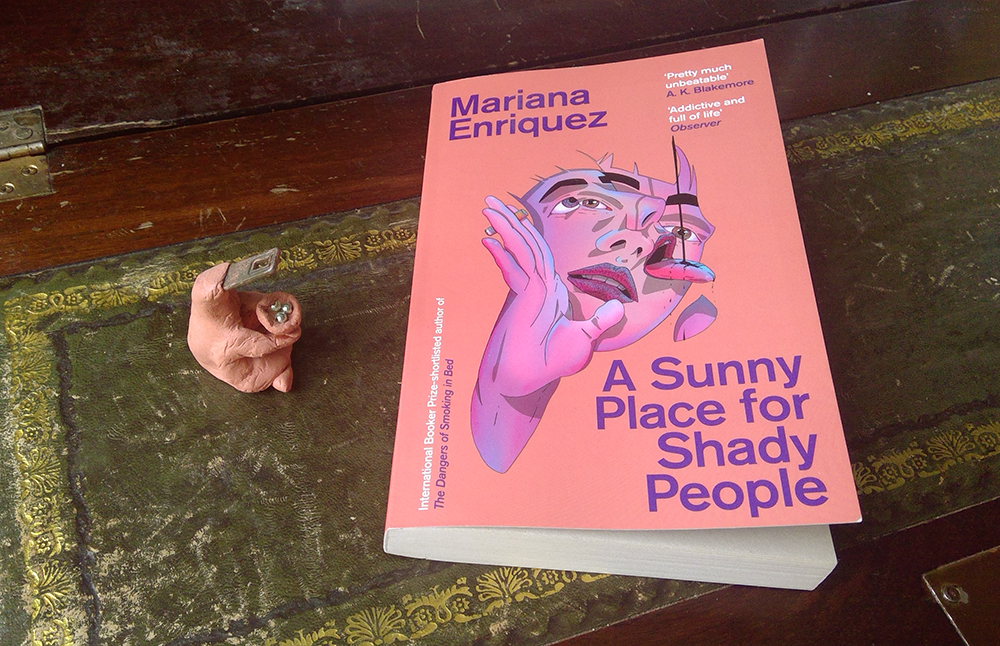
I’ve mentioned the cover already, but it is a really great selling point for these Granta editions. The illustrations on the front aren’t bespoke for the books, though I think the one for the forthcoming Somebody Is Walking on Your Grave appears to be. When I reached out to the illustrator, Pablo Gerardo Camacho, he mentioned that Granta approached him, apparently having been impressed by his collection of haunting multi-faceted and otherwise macabre compositions. You may also recognise his style from Marlon James’s Black Leopard, Red Wolf and its sequel. There is a great interview with Camacho at queerthology book club here, but I wanted to know more about the two illustrations which feature on pages vii and 255 of A Sunny Place… (see below).
According to Camacho, these were bespoke illustrations for this collection, inspired by the stories, though he wasn’t sure at the time of asking which story the illustrations related to (he mentioned the work on page vii possibly being inspired by the first story, “My Sad Dead”, which does have some window moments, but I’m not 100% sure). What is for certain is that they are pleasingly horrible images, pointing towards the more overtly horrifying end of the spectrum of atmospheres that Enriquez is working with in this book. I always appreciate little touches like this in books: to me it signals that the creative team were able to put that bit extra into amplifying the reader’s experience.

Incidentally, the black, ichorous liquid pouring down onto the tongue on the cover was originally white. There are a couple of strange images involving milk in this collection, so it could have worked well, but I can see why the publisher may have wanted to change it. I should also say that Luke Bird is a publishing design powerhouse and it is well worth checking out his portfolio on his site. Now, to the matter of the tales themselves…

The stories
My Sad Dead
A Sunny Place for Shady People
Face of Disgrace
Julie
Night Birds
Metamorphosis
Hyena Hymns
Different Colors Made of Tears
The Suffering Woman
The Refrigerator Cemetery
A Local Artist
Black Eyes
Acknowledgments
My Sad Dead
In a district of a big city (I was imagining Buenos Aires, but it isn’t specified) where random criminal violence has become tiresomely commonplace, a mother/daughter tells us of her growing connection with the local dead, starting with the reappearance (and crucially, unwillingness to leave) of her own mother. This tale reminded me of “The Dirty Kid”, the opener from the author’s 2016 (English: 2017) collection Things We Lost in the Fire, with its vivid portrayal of the weirdness of crime characterised by abduction and random killings – and disproportionately focused on the youth of the area. “My Sad Dead” establishes that Enriquez’s ghosts are sometimes – actually, often – sympathetic creatures or characters, and makes excellent use of this potential for empathy to expose the intolerance, or just apathy and wilful ignorance of the narrator’s neighbours and the local community. Beyond the supernatural, we also see the strain and strength of the narrator’s relationship with her own daughter, with Enriquez typically managing to weave a decently affecting intergenerational relationship drama into a story that might, in lesser hands, be dominated by imagery of faces falling off and bloodstained spectres.
It also introduces us to themes which will play into the rest of the stories; the rotting of bodies and corruption of youth/vitality; having more in common with the thing which should typically be shunned (ie. the dead or disgusting) than our living community; and a sense of fatalism and exhaustion in the face of forces too great or complicated to be overturned or avoided…
A Sunny Place for Shady People
The treatment of urban legends and the people who obsess over them in this one reminded me of the forums discussing people “coming back different” in Julia Armfield’s Our Wives Under the Sea (2018). This a rich vein to mine for modern storytelling as its so believable, but also brings the context of our internet age into a horror space without falling into the banality trap you risk tripping when describing internet activity in literature. Enriquez amps up the credibility here by featuring the real-world figures/creatures of P-22 (the Hollywood Puma), serial killer Richard Ramirez and Elisa Lam, the victim, now ghost, that the reporter/narrator is investigating. As the reporter’s former lover also crosses into this enigmatic urban legend territory in her disturbing recollections of their time together, it all coalesces to form one of Enriquez’s most impactful stories, set against a lonely, brutal, dislocated and sickening LA (as established by the Jack Kerouac epigraph).
Face of Disgrace
The second story in the collection to explore the imagery of facial erasure – in the first story it was via direct violence and the ravages of death, whereas here the living are afflicted with a gradual shrinking and blurring of their facial features to a sort of featureless living mask. Here Enriquez configures a chain of intergenerational trauma triggered by a disturbing sexual predator, configured with the weird attributes of a cryptid or a folkloric creature (no face, backwards feet, whistling without a mouth). Just as the real-world terrors of crime and the intolerance juxtapose the supernatural in the first tale, the grim realities of anonymised male sexual violence, trauma and alcoholism underpin the urban legend/body horror elements of the tale here; culminating in a fittingly shocking and feverish ending. Enriquez’s association of the central “creature” in this kind of folk-legend space is really interesting to me, and I’ve been thinking about her choices about when the horror-transformation takes place for each of the characters afflicted (and of course its skipping of the son, which coincides with a shift in the narrative voice.)
There’s a provocation in the title too, about to whom the “disgrace” should belong – clearly the original attacker should receive the reader’s condemnation, but the gradual alignment of the women to whom the secrets are passed with this original creature creates a more complicated picture of this concept of “disgrace”, further developed by the literal covering of the partly erased faces with Halloween monster masks at points in the story. Commentary perhaps on society’s tarring of victims with disgrace and disgust in association with dark acts out of their control. Properly haunting and to me this is quintessential Enriquez.
Julie
“Julie” opens with a quotation from the occultist/Thelemist writer and artist Marjorie Cameron (sometimes self-styled “Cameron”): “I shall plunge down into the abysmal horror of madness and death—or I shall walk upon the dawn.”1 Some preceding text (“This is the fateful hour in which I drink the cup of poison its dregs”) and the context suggests that Cameron is talking about a peyote-induced ritual in a kind of kill-or-cure scenario, following the death of her partner Jack Parsons (in a lab explosion no less). With regards to this story, it could be seen to act as a kind of foreshadowing of attitude assumed by Julie, the gringa visitor to the narrator’s family, whose “communing” with ghosts (with accompanying pleasures) and slovenliness is reviled by her family, but comes to be an opportunity for community and salvation/oblivion from the demands of society.
Another great use of the possibilities of fringe internet cults in horror fiction, and there’s an interesting satirical edge at play here – another inversion like “My Sad Dead” about the things “we” should be afraid of or disgusted by, and what happens if the standard horror-fiction reaction is not shared by the “victim” of the hauntings, or possibly our narrator. Mental health analogies mingle with classic Exorcist-style horror tropes, and also the drudgery of everyday family grievances to lend this one a disquieting and thoughtful tone.
I have seen some accusations of fatphobia here in the portrayal of Julie, though I wonder if this is Enriquez intentionally leaning into an uncomfortable narrative viewpoint as she has done in many of her stories (and it certainly is uncomfortable). Without spoiling anything, I think we are supposed to be sceptical of the narrator’s motives and the resolution of the final scene.
Night Birds
The epigraph explains that this story was written “under the influence of Mildred Burton”, the Argentine artist for whose posthumous exhibition, Fauna del país, Enriquez originally wrote this story (under the title of “Millie”. You can read it here.) With this in mind, the unravelling of the story of “Millie” (a representation of the artist) and her struggles with ketoacidosis (or acetonemia in the original translation) is given an off-kilter twist through its narration by her “sister”, who is perhaps an imaginary muse invented while the artist was bored in hospital. Channelling Burton’s work on transformed animals and rotting bodies, this is another story featuring facial annihilation and a figure of conventional disgust as visual themes, again configured through relationships of sister- and daughterhood. I wondered if Enriquez had read Witold Gombrowicz’s Cosmos in relation to the part that Millie’s adopted cat plays in the story, but it is likely a coincidence and instead based on an anecdote from Mildred Burton.2 The interplay with daily decay, illness and fractured family life with mythology, and particularly the violent or subjugating transformations of women into birds and animals in traditional folklore, works well to stoke this into a feverish read.

Metamorphosis
Once again we open with an epigraph, this time from Sonia Budassi’s 2022 collection Animales de compañía: “The body is not a punishment: the punishment is that people talk about the body so much that it hurts to have it.” This cues us up for a story ploughing into a weird metaphor about body autonomy and non-conformity to societal and medical expectations (this time about cervical health and massive fibroids), perhaps with a little commentary on fringe communities and the industry of illicit body modification (taken to an extreme here – or is it actually extreme? Perhaps this is the question left with us as we wrangle with dinosaurian hybrid allusions and the notion of return to a pre-human state.)
Hyena Hymns
A couple, Mateo and our male narrator, are weathering a trip to Mateo’s parents’ fancy house in (maybe) Corrientes (based on the zoo fire that is mentioned?), in one of Enriquez’s exercises in spinning a more traditional horror yarn. Alongside the talk of rewilding hyenas (or are the cries in the night from the spirits of those who burned in the zoo fire) and issues of gentrification and class problems in the town (or city, as the father is quick to interject), we are also taken on a visit to a castle haunted by a traumatic past use as a concentration camp. I’ll say no more, but this story was well placed to land a more visceral horror-hit after some quieter stories. The Cormac McCarthy epigraph from Stella Maris asks whether these sites of lingering, living misery will inevitably be torn down, or instead become “temples”, bringing a sense of the ritual nature of hauntings and the relationship between their spirits and witnesses.
Different Colors Made of Tears
On paper, another conventional horror-story setup here, though in an innovative context of workers at a modern, trendy vintage shop collecting donations from an unknown bestower. I would rather not give too much away here as I think this was one of the more affectingly shocking tales, like “Face of Disgrace” approaching the subject of male violence and hatred for women as the catalyst for body horror and manifestations of disgust. In its rendering of a kind of spontaneous wounding at points in the story, I was reminded of some imagery from the film Velvet Buzzsaw (2019).
This story’s epigraph,
Oh, this wound the color of old clothes,
it splits, it smells of scalded honey.
is from César Vallejo’s poem “Absolute” (“Absoluta”, published in 1918. You can read the whole thing here.) Fittingly violent and sickly/sensuous lines to guide us into this tale. The title is a lyric from The Velvet Underground’s song “Venus in Furs” (1967), which gives us a link back to the 1870 novella of the same name by Leopold von Sacher-Masoch (after whom “masochism” is named), establishing the territory of perverse sexuality, fetishised clothes and cruelty from the off.
The Suffering Woman
Claustrophobia, agoraphobia, possible timeslip or dimensional travelling – and the returning themes of illness, isolation and their impact on mental health. There’s an interesting relationship with a kind of sympathetic connection developed through the possibly supernatural crossed wire communications received by the narrator, although the ambiguity about what is healthy and what is obsession. Read as another episode of meditation on illness, acceptance of death and the way in which society isolates those facing either, it’s a thoughtful piece with a tight focus on the weirdness of everyday life, possessions, messages we send each other, home. Katherine Mansfield’s quotation at the opening of the story chimes with this theme of death-acceptance and the panic that it can invoke.
The Refrigerator Cemetery
Enriquez kicks us off with a modern stalwart of the uncanny, Thomas Ligotti, and a quotation of his about that which is ordinary, but which can gain a supernatural significance as a conduit to another realm. Here, based on the title and the events of the story, the titular cemetery of discarded and worthless white goods comes to be a portal back into an unhealed trauma for the narrator, pushing them towards an escalating unravelling with reality stemming from their shame over a childhood game gone wrong. Some strong and unpleasant imagery, and one of the author’s more developed-feeling narrative voices (believable in their self-delusion and coping mechanisms for some terrible moments in their life). Like “Face of Disgrace” and “Hyena Hymns”, there’s an essence of the urban legend to this one, centred as it is around the kind of grim story you can imagine circulating at school.
A Local Artist
Again, on paper we are treated to a tried and true Gothic horror setup – a holiday in a small town, but why are the people so weird? Are those bloodstains? Who is this mysterious figure people keep referring to? This reminded me of the author’s story “Under the Black Water” in its overt veering into what some might consider “actual” horror – that is, an encounter with something properly freaky and tethered to some kind of bizarre reality (rather than hinting at or blending into possible delusion as some of her other stories tend to do (not that I am averse to that!))
Without mentioning anything specific, parts of the story conjured imagery from surreal artists like the aforementioned Mildred Burton, as well as Leonora Carrington. Enriquez’s ekphrasis (art-writing) is on point in making the weirdest episodes weirder, and the bathos of the charming title’s interaction with what actually unfolds is the cherry on top.
Black Eyes
Enriquez closes on a chiller, and some of the most memorable imagery of the book. I can’t spell it out, because it will make you think it is more of a significant part of the story than it is to know in advance, but there is one short (and literal) throwaway thing which has stuck with me from near the ending. Anyway, this one plunges us back into the throes of urban life, with characters trying to help the homeless in the city. As we know from horror media, not all who ask for help are on the level, and the particular character of these weird interlopers here is pretty unexpected. I think there is some interesting imagery at work in their description relating to Argentina’s colonial past, and there’s something cynical and fatalistic about the encountering of dangerous horror in an employment already shot through with trauma and exhaustion, aiming to help the fringes of society (and pushed further in this story all the way to the lonely fringes of the city).
The epigraph from Richard Gavin seems to suggest that encounters with “the Minotaur in the maze” are inevitable: in the mazelike streets of the city, of course there is lurking evil, and perhaps it has been here the whole time.
Acknowledgments
In an interesting use of the acknowledgements section, Enriquez gives us an extensive list of musical references which inspired moods and themes for the stories, from big names (Sinead O’Connor, Patti Smith Group, Lana Del Rey, Nick Cave and Taylor Swift) to rock and metal acts such as Darkthrone, Gabo Ferro and Sergio Ch. I like the candour of this, and after finishing the book I cued up some of the suggested songs and albums for listening in the following days while thinking about the stories still.

So, would I recommend?
For me it worked well to have some stories in this collection diving further into more conventional horror formats (spider-fiends, worm-guys), with others exploring a subtler space more akin to an unnerving nightmare than a vehicle for outright shocks. (The title alludes to the duality of sunshine and shade; is it fitting that there are starkly different tones and moods to be found across the collection?) I think the intertextuality with the epigraphs and art influences adds greater depth to the tales, and I enjoyed the appearance and reinterpretation of the repeating threads and themes which I have pulled out above, for the most part.
I do think there are moments in some of these stories where I started to wonder where we were going, and reading all of them back to back can create a strange feeling of recursiveness when some of Enriquez’s favourite story devices and thematic beats crop up again in subsequent stories. Having said that, even if some tales felt a bit more meandering in terms of how the supernatural or psychological threat develops or is interpreted by the narrators, I appreciate that Enriquez’s characters often have more going on than the standard weird fiction protagonist or victim. Her treatments of trauma, real-world encounters with the atrocious and the humour in well-observed relationship chatter are elements worth mulling over – and sometimes end up having the greater impact over the more outré thrills. I think this is where I would place her writing above some contemporaries; the way she can make the tug of gritty reality, sometimes partly obscured by ghosts and body horror, be the thing which continues to drag at your mind after you finish reading, is exemplary.
Having first encountered it in Things We Lost in the Fire, I also loved returning to Enriquez’s uncanny vision of an Argentina (and a USA) underpinned and overwhelmed by dark histories and the newer dreads of sinister cults and societal ills. So, thoroughly recommended, and I’m looking forward to catching up with The Dangers of Smoking in Bed after these tales have had time to fully settle into my subconscious.

Most wobbling tale award: the nauseatingly visceral “Different Colors Made of Tears” will stick with me for a long time. Something about the concept of spontaneous mutilation borne from an undying hatred is truly shudderworthy.
While Things We Lost in the Fire gave me one of the most enduringly horrible images I think I’ve encountered in… all fiction(?), this one’s key mystery left behind to wobble in my brain is probably the incongruous appearance of a bag of milk.
If you would like to purchase your own copy of the book, I recommend buying direct from Granta, or from an independent book shop in your area. ¡Hasta la próxima!


Production and publishing-specific notes
- Production-wise, the cover makes good use of spot UV varnish on the main illustration and a sensible amount of the text (some publishers seem to pile it on to everything for the hell of it), and the soft-touch lamination (or supermatt?) feels good. The paper inside is a bit of a lower grammage than one might want for £9.99, but this is pretty standard for popular paperbacks. I’m not sure what gsm this actually is (maybe 55?), but it feels a bit flimsy and transparent. The money spent on the spot UV for the cover possibly could have been better spent on improving the general paper quality, but that’s the production nerd in me speaking.
- Granta have been tactical (or very mildly cheeky, perhaps) with the quotation from A. K. Blakemore, which originally comes from their Guardian review in which they say the collection felt uneven: “I was disappointed that this collection oscillated so often between too much and too little. But it did nothing to shake my conviction that Enríquez, when she does just enough, is pretty much unbeatable.” (my emphasis). Since it’s a Guardian review, it reminds me of one of the greatest examples of sleight of hand involving a not-100%-positive review, for the Kray Twins film Legend (2015).
- Granta have opted to render the author’s surname without the diacritic í (Enríquez), which raises an interesting question about the role of accents during translation (if the reader will be pronouncing the name in their own tongue, is the accent defunct?). It may also be that it was easier to render without, and the author didn’t mind either way.
- Translator Megan McDowell’s name appears quite small near the barcode on the back, which seems a bit of a shame when the design includes two review quotes, as well as an “also by” mention, on the front. The Society of Authors hosts an open letter for the #translatorsonthecover campaign, which I think is probably the right move considering the significance of the translator’s contribution to a reader’s experience of a work. There may of course be more context at play here about the translator’s own preference about the nature of their attribution. This also opens up a broader topic about recognition for all kinds of roles involved in the publishing of a book. Often there are many hands who go unsung in the final printed copy of a book, though in recent years I have seen more publishers listing out the roles and who performed them on the imprint page (examples of publishers who do this being And Other Stories and Indigo Press).
- As pet peeves go this is going to sound pernickety, but the running heads in the main section of the book are structured to have the author name on the verso, and the collection’s title on the recto. So, this means that I know at any given point what book I am reading, but not much else. I think it would be much more useful in a short story collection to have the short story title on the verso. This also makes it easier to flip forward and figure out how much longer the current story is, for those moments when you know you need to go to sleep, but you also can’t resist trying to finish a tale in one sitting. (I know I am guilty of managing/producing books where this wasn’t necessarily done with the running heads, and yes, I do regret that!)
footnotes (use the arrow links to return to the text):
- Cameron’s works get a good round-up at the palianshow/Art by Women blog here (this found while trying to find where the quotation actually comes from. Sidenote, it is really hard sometimes to find a source for a quote on the internet when so many people and sites just repeat it without any attribution. For the sake of it being somewhere in connection with Enriquez, it appears to be from a letter Cameron wrote to fellow occultist Jane Wolfe in December 1952, according to page 59 of this article.) ↩︎
- I wonder now if the raw deal for the cat in “The Neighbour’s Courtyard” in TWLinF was also inspired by Mildred Burton, although anyone immersed in horror fiction will know that cats often can’t catch a break. ↩︎

Have you read any of the stories from this collection? I’d be intrigued to hear your thoughts.
Leave a Reply