Tales of the Weird

In 2018 I was part of the team at British Library Publishing who brought five anthologies of strange tales together to become the first season of the Tales of the Weird series. From then until June 2025 I was series editor, and as an external editor I helped put together the next set of titles up to June 2026 while the new editor, Rufus Purdy, laid the groundwork for the next batch of haunting books.

I have assembled some information about the series here, and will share some insights, tidbits and weird episodes from the history of the series via the blog.
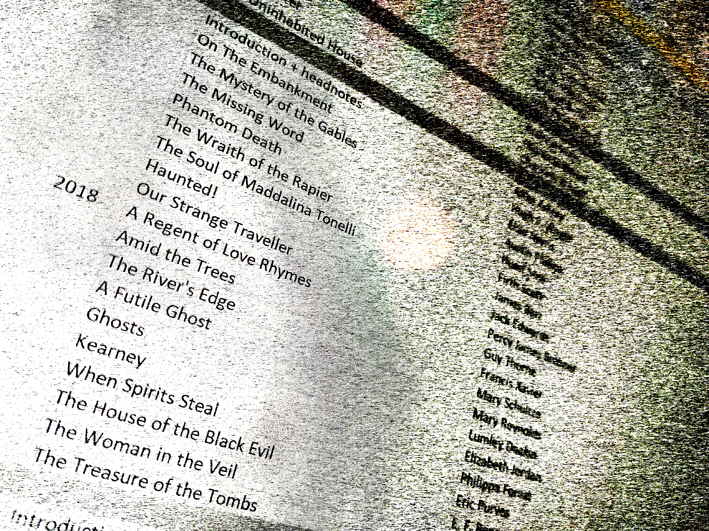

Contents sheet

Mosey around my searchable contents sheet for the series (coming soon).


Gallery

A collection of the final versions of each of the covers, with notes along the way.


Blog posts on the series


Latest post

  • Haunted Yorkshire

    Haunted Yorkshire: Ghostly Tales from God’s Own County

    Cover – Design by Mauricio Villamayor, illustration by Mag Ruhig
    Frontispiece – Mag Ruhig

    Introduction, headnotes and acknowledgements – Elizabeth Dearnley

    The night is darkening round me – Emily Brontë
    The Boggart of Hellen-Pot – Sabine Baring-Gould
    The Striding Place – Gertrude Atherton
    The Garside Fell Disaster – L. T. C. Rolt
    Maiden in the Moor – Elizabeth Dearnley
    The Happy Children – Arthur Machen
    Corstophine – E. F. Benson
    Natural Remedies – Andrew Michael Hurley
    Madam Crowl’s Ghost – Joseph Sheridan Le Fanu
    Beckermonds – Phyllis Bentley
    All the Dead Dears – Sylvia Plath
    Concerning a Wonderful Encounter between a Ghost and a Living Man – ‘A Monk of Byland
    Gilbert – Charlotte Brontë
    The Trainer’s Ghost – Lettice Galbraith
    The Gytrash of Goathland – Michael Temple
    Stories of the Craven Dales – T. Q. M.
    Melsh Dick – F. W. Moorman
    The Deadfall – Ted Hughes

    Buy a copy now from the British Library


    Notes and tidbits

    It’s hard to pick favourites from Elizabeth’s selection, which is brimming with some of my favourite kinds of tales, in which folklore has been cleverly reinterpreted by skilled writers. Elizabeth is always good at pairing up the older tales with some intriguing modern selections, and the Plath story is a highlight here, lent a strange extra dimension by the inclusion of the (also very good) Ted Hughes tale. Some thoughts on specific stories…

    I really enjoyed seeing the humble squirrel becoming the source of terror in this one, especially since goblin and evil-fae stories often position the fairy creature as the main threat to their unlucky victim. F. W. Moorman doesn’t hold back with the dialect of the narrator in the nested tale, but I think it does help sell the folkloric nightmare that unfolds here.

    Moorman was a dedicated folklorist, researcher and poet, holding the post of Professor of English Language at Leeds University (before one J. R. R. Tolkien assumed the role following Moorman’s untimely death). Moorman’s poem ‘The Dalesman’s Litany’ became a popular folk song – that link takes you to the rendition from Tim Hart and Maddy Prior’s 1968 album Folk Songs of Olde England Vol. One. Apparently Moorman claimed that Beowulf may be a work of Yorkshire literature based on the possibility of Geat settlements, which is very intriguing. Researching this writer with Elizabeth made me feel like there’s more to unpack in his work. Like Sabine Baring-Gould, his deep interest in cataloguing folk material and adding to the tradition with his own art makes me feel some affinity for him.

    The author name given in the book is how M. R. James referred to the writer in his note on the transcription of the Byland Abbey ghost stories in 1924. If you’re intrigued to read more of these tales, Nina Zumel has made a pleasingly presented website building on work that David Mimno had been doing on github. You can also read the stories directly from volume 27 of Yorkshire Archaeological Journal (1924), courtesy of Archive.org.

    At one point in the story, the narrator says:

    And when he conjured the she-goat she fell prone upon the ground, and rose up again in the likeness of a man of great stature, horrible and thin, and like one of the dead kings in pictures.

    Firstly, she-goat. Excellent. Secondly, M. R. James speculates that this ‘dead kings’ reference is an allusion to the theme in medieval illustration of the ‘Three Living and the Three Dead’. I like this. It feels very modern somehow to throw out a visual reference in this way, like a meme for fellow monks, especially for a time when access to art and illustration would have been far less widespread. The monks of Byland Abbey would of course have been educated in the symbolic themes in the art of manuscripts and illumination (and would have been creating new images themselves, drawing on some of these established conventions). Maybe it’s just the familiarity which is endearing, inviting us to feel like one of the brethren. ‘Ah yes, brother, I know those big dead kings. I have painted a great many.’

    Unimpressed Kings (and Very Thin Hawk) meet Big Dead (and surprisingly cheerful) Kings. Detail from: Robert de Lisle Psalter, British Library, Arundel 83 II, fol. 127.